Showing posts with label nostalgia. Show all posts

Tuesday, 22 December 2020

Pub closures – an ongoing misfortune

The closed down Old Ship
The Christmas and New Year holiday is often an occasion to reflect on the past as well as look forward to the future. This post is about a couple of local real ale pubs that I used to frequent but which are now closed.

First is the Old Ship on Eastbank Street, Southport. I discovered this pub at a time when I was helping run a folk song club that had become homeless. A friend who worked at the brewery (Tetley Walker) arranged for us to use the function room which became our club's home for several years. I began to go there at other times and made many friends there.

The manager Charlie Oliver was popular and was known for his well-kept Walkers ales. Bikers liked the pub, which had a great rock juke box. I remember Meatloaf was blasting out with “I'll do anything for love but I won't do that”. One biker at the bar asked, “What won't he do for love?” His mate replied, “Lose weight.”

On another occasion, a young man was being obnoxious. When Charlie politely asked him to leave, he began to argue, at which five bikers simply stood up. He then decided discretion was the better part of valour and hurriedly left.

The Falstaff after its last short-lived refurbishment
The Falstaff on King Street later became my local, and we used to hold informal song sessions there. It was managed by Gail Heyes (now at the Guest House), had an extensive choice of well-kept real ales that drew drinkers from far and wide, and a good value food menu as well. We held a few successful musical charity fundraisers there. Unfortunately this pub later had two extensive refurbishments in the space of 18 months, the most recent just over four years ago. 

Regrettably both of these pubs have been closed and boarded up for some time, two of the 13,600 pubs that have closed in the UK since 2000. People walking past them now just see boarded up buildings, and most will be unaware that they used to be thriving community pubs, focal points for people to meet, have a few drinks and enjoy each other's company.

I'm sure most pubgoers realise that pub closures will accelerate as a result of the current pandemic. Our towns and cities will have more boarded up pubs to be sold for change of use or redevelopment. The government seems intent on doing the bare minimum to help - what's been offered has been wholly inadequate - and indeed seems to be opting for tier restrictions that are doing more harm than good. I'm not convinced that this is entirely due to their habitual incompetence - I suspect that there may be a hidden agenda, as I wrote here in September - but either way, the vaccine rollout will come too late to save thousands of pub from closure.

Friday, 3 July 2020

Tales of tipples past

When I was 17, our scout troop went on a camping trip around the area where the borders of Austria, Yugoslavia (as it still was) and Italy meet. In Austria, we were staying near a city called Villach (pronounced Feel-ack). The local beer was Villacher Bier, which in itself we found mildly amusing because out loud it sounded to us a bit like 'feel like a beer'. About all I can remember is that it was a golden-coloured beer.

One evening, we were sitting in a beer garden and, having studied German briefly, I was instructing our group how to order beer in German ("Ein Bier bitte ... zwei Biere bitte ... drei Biere bitte ..." and so on). Some of the other drinkers were laughing at us when a dog walked in. It wandered hopefully from table to table and was completely ignored until it came to us; we of course patted and made a fuss of it. The dog with tail wagging furiously was loving every second of all this unaccustomed attention, but from the neighbouring table I heard just one word: "Englisch!"

••••♦••••

The Scarisbrick Hotel
In the late 1970s, at a time of petrol shortage, I had been to a party on the other side of Southport and in the early hours was cycling home on a bike borrowed from my brother. As I approached Lord Street, the main shopping street in Southport, it began to sleet and the bicycle chain broke. I managed to fix it, but it broke again a few minutes later.

Lord Street has a long canopy for most of its length so I was sheltered from the worst of the weather for part of the journey home, but it was going to be a long walk, until I had an idea, the kind that usually only occurs to you after a few pints. Treating the bike like a kid's scooter with one foot on a pedal and the other pushing on the ground, I was getting quite a good speed up.

Halfway along Lord Street is the Scarisbrick Hotel, something of a local landmark, and outside was standing a young policewoman. As I approached, she held up her hand to stop me and said: "I know there's a petrol shortage. Are you economising on bicycle oil?"

••••♦••••

A few years later, I'd had several pints in the Park Hotel, a pub in Birkdale, and then went to a wine bar called the Grape Escape on Lord Street (now Waterstones book shop). A young lady helped me dispose of a couple of bottles of wine and promptly disappeared when the last one ran out, after which the bar shut anyway so it was time to go home.

As I started out, I realised I was going down a one-way street the wrong way so I carefully turned around and went a longer way home to avoid breaking any more one-way street regulations.

When I woke up the next morning, I remembered all of this - including the fact that I hadn't been driving: I'd been on foot all evening.

Wednesday, 19 February 2020

Peter Walker - a personal reflection

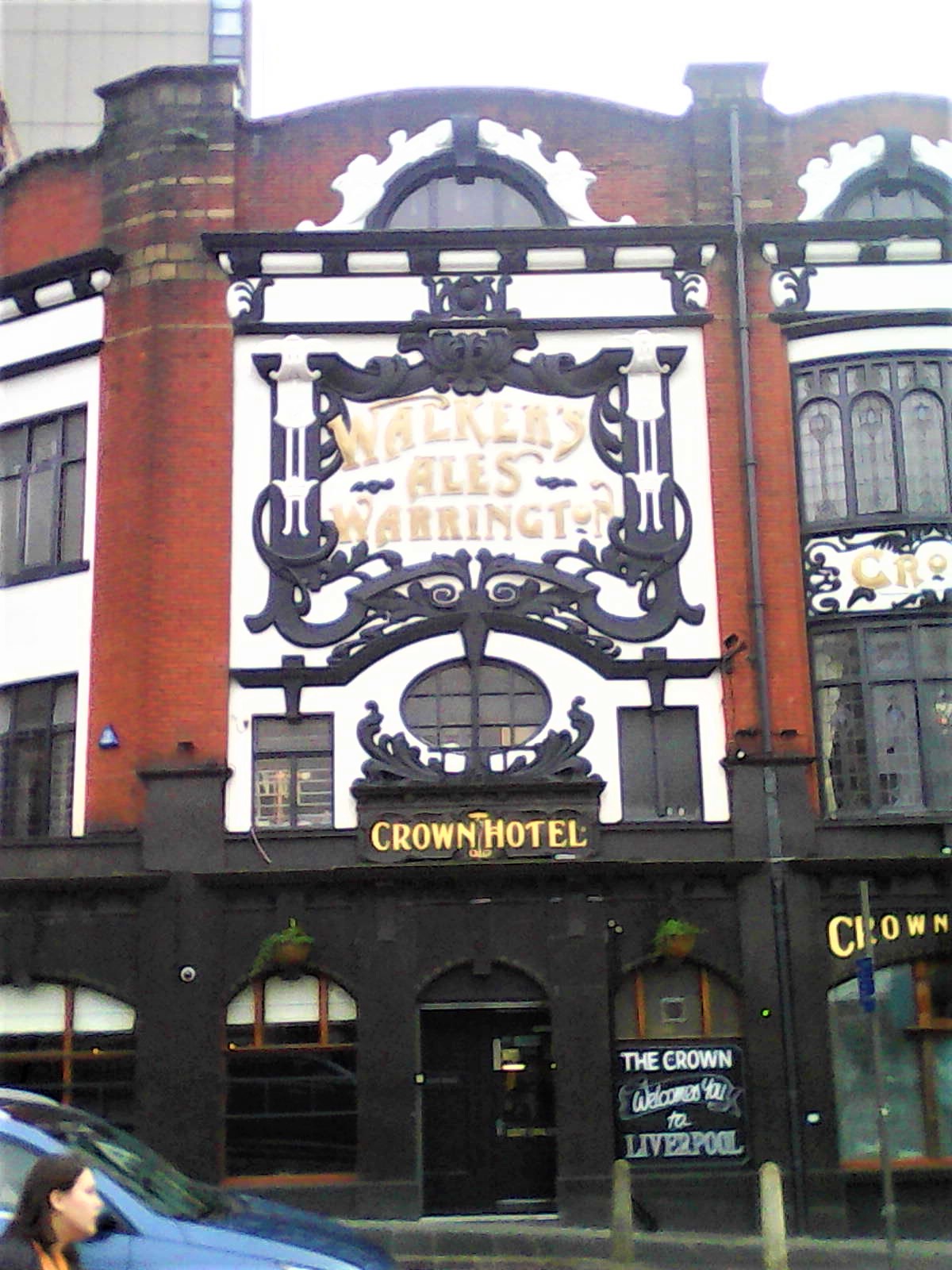
The Crown, Lime Street, Liverpool
I was a student at Padgate College in Warrington in the 1970s. The area at that time had three breweries: Burtonwood, Greenall and Tetley, although you wouldn't have known it because the vast majority of pubs were Greenall's. The brewery's adverts told us to, "Smile please, you're in Greenall Whitley land". They produced funny beer mats and even 'GWL' car stickers, like the 'GB' plate you use when driving abroad. I sometimes used to wonder whether they had ever caused any confusion at border checks on the continent. If only they had put as much effort into the beer as they did into the hype because, at best, Greenall's beers were mediocre.

I don't recall any Burtonwood pubs in the town, and most of the few non-Greenall pubs were Tetley. Tetley's beers were better than Greenall's but not by a great margin. Tetley had merged with Peter Walker in 1960, and in the 70s, they were still brewing the old Walker's Bitter, although they sold it under the Tetley name, which I found slightly odd seeing that most beer drinkers I knew preferred the Walker's Bitter to the Tetley's. The local CAMRA branch produced stickers for the few pubs that still sold Walker's to put in their windows, something my friends and I found very useful.

I had a sort of family connection to Walker's because my maternal grandmother had worked in Walker pubs for many years, as did her son, my Uncle Bernard. He rose to be manager of several pubs, and I can remember visiting two as a child, the Sefton Arms in Croxteth and the Victoria in Bootle. My grandmother used to be his relief manager on his day off. I remember calling into the Victoria for a pint a couple of times when I was older and working in Bootle; he was rightly proud of the quality of his beers. In later years, knowing about my involvement with CAMRA, he was pleased when I told him that he had kept an excellent pint.

At some point in the 1980s, Tetley Walker decided to relaunch the Walker brand. Some Tetley pubs were re-badged as Walker's and new beers formulated. In the process they scrapped the old Walker's recipe, which had been around 3.5%, like many beers at the time, and replaced it with Best Bitter (3.5%), Bitter (3.3%), and an even weaker mild. The beers weren't bad but I preferred the old brew. Later added to the range was a stronger Warrington Ale and a Winter Warmer, both of which I did quite like.

The 3.3% strength of the new Walker's Bitter became something of a joke in Liverpool:
Policeman: "Excuse me sir, have you been drinking?"
Driver: "Yes, officer, Walker's Bitter."
Policeman: "Very good, sir, carry on."

Walker's beers are no more, possibly disappearing around the time of the 1989 Beer Orders, but the name can still be seen on quite a few pubs in Merseyside, as shown in the photographs which I took in Liverpool yesterday.
The Vines, Lime Street, Liverpool
P.S. Since I posted this less than an hour ago, it has correctly been pointed out to me that someone is brewing a smoothflow version of Walker's Bitter, although I've no idea who or where. When saying that Walker's beers were long gone, I was thinking of the Warrington-brewed beers. Anything else would be a poor facsimile just to cash in on the name.

Sunday, 1 July 2018

Real ale in Southport - 1985 and now

While sorting out some books in preparation for a house move, I came across a 'Merseyside Guide To Real Ale', published in 1985, a booklet I'd completely forgotten about. It cost 50p (£1.53 now, so it was quite a bargain) and is a fairly slim volume which could easily slip into a coat pocket. As was usual in those days, the pub descriptions were rather sketchy, but I think it's safe to assume, in an age when beer choices rarely changed in pubs, that the beer situation was accurately described. This was published four years before the Beer Orders which turned the pub world in its head.

Looking at Southport, where I lived then as now, there were 25 pubs, bars, clubs and hotels listed as serving real ale. There were quite a few more non-real ale pubs, of course. In contrast, off the top of my head I have counted 41 outlets that currently serve real ale in the same area, and there may be one or two others that have slipped my mind.

Most of the beers sold in pubs were from the brewery that owned them and, as the chart shows, most pubs had only one or two real ales on. Nowhere had more than four real ales, and only one real cider was listed (Bulmers Traditional). In contrast, serving four or more real ales is quite commonplace in the town nowadays, with a few venues hitting the eight to eleven range. Real cider is still fairly uncommon in Southport, but at least we can do better than just one.

Unusual beers for the time in this area included:
  • McEwans 70/-
  • McEwans 80/-
  • Youngers No. 3
  • Boddingtons Bitter
  • Marstons Pedigree
  • Ruddles County
  • Wilsons Original Bitter
All the rest were standard house beers from Allied Breweries, Bass, Burtonwood, Whitbread, and Matthew Brown/Theakstons. I know there was a couple of Greenall Whitley houses but I presume none sold real ale. As variety goes, this all looks fairly tame today, even the comparatively 'unusual' choices, although it's worth noting that in 1985, Pedigree, County and Boddingtons were much more highly rated than they are now.

It strikes me that, in all the doom and gloom over pub closures - and some venues listed in this guide have since been lost - we may forget that overall the situation is a lot healthier in terms of choices of beers and places to drink them than ever before, largely due to the numbers of micro-breweries and the rise of micropubs and other bars serving real ale.

I am not blasé about losing traditional pubs, and I know that some people consider the market is over-saturated with breweries and micropubs that may not survive in the long term, but despite all that, I can simply say that I much prefer to drink in today's Southport than that of 1985.

Sunday, 19 February 2017

Old Roan memories

The Old Roan (picture borrowed
from the petition set up to save it)
Unusually, I was driving towards Liverpool last Thursday (I almost always go by rail nowadays) via Aintree. I used to drive this route every day for 13 years when I worked in Norris Green, Liverpool 11, until I transferred to Southport in 1993. I was expecting changes, and there were certainly plenty. However, what I wasn't expecting to see that the Old Roan pub was boarded up. Checking on-line later, I saw that it has been closed for 3 or 4 years and is up for sale for conversion to retail premises. There was an unsuccessful petition (now closed) to Sefton Council Licensing Unit to allow the pub to reopen.

This pub was something of a highly visible landmark, giving its name to the surrounding area and to the nearby railway station;  I don't recall it ever selling real ale. However, when I worked in Norris Green, I'd sometimes offer Wally Warren, the deputy manager, a lift if we were leaving work at the same time - we both tended to work late; he lived near the pub and it saved him a slow bus trip. Sometimes he'd offer to buy me a pint, and in we'd go. I was the union rep in the office, but no cosy deals were stitched up there.

For a while, we had a manager who seemed to have a skill in getting on everyone's nerves. After he'd been moved on, Wally told me that he'd learnt about our occasional drinks and asked, "Is it fruitful?" Wally replied that I didn't let slip anything that I shouldn't, and neither did he as a member of management; he added that the boss never trusted him again.

In negotiations, Wally and I crossed swords on several occasions, but it wasn't personal. He was an old-school manager with integrity, even if he could be a bit grumpy on occasions; overall the staff liked him and tended to tolerate his little foibles with a knowing smile. I learnt a few years ago that he'd died; if I'd known I'd have gone to his funeral.

As I drove past the Old Roan, all these thoughts came back to me and, although the beer wasn't up to much, I look back on those pints in that pub with fondness and, I'd go as far to say, friendship.

One of these occasions was the last time I drank a pint of keg lager. Wally bought it for me in error and offered to replace it when he realised his mistake, but I just accepted it. After all, it wasn't as though the Old Roan's bitter was much better.

Cheers, Wally!

Monday, 23 January 2017

A star is imported

I see that Kingfisher Beer Europe intends to import Bintang into the UK. Bintang is an Indonesian beer, a Pilsner with a strength of 4.7%. Normally I'd say: "So what?"

My father was an expatriate worker in the cigarette industry, and his work took him to many countries, a few of which I visited when I was a child and a student. One of these countries was Indonesia. We lived in a provincial city called Semarang in central Java. The most popular beer available everywhere was Bintang, brewed by a local subsidiary of the Heineken group, and the bottles prominently feature the Heineken star, after which the beer is named: bintang is the Indonesian word for star.

I'm thinking back to the mid-1970s now, but as I recall it was quite a reasonable bottled beer which, ice cold straight out of the fridge, was just right to slake your thirst in the hot tropics (Java is just below the equator).

I shall keep an eye out for it. According to the report I read, it will be imported. If so, I'll give a try, if only for old times' sake. If, on the other hand, it is brewed somewhere under licence, I'm not sure that I'd bother.

This is my 1,382nd post. It is the only one written solely about lager.

Sunday, 29 November 2015

Mixing your drinks

Black and tan
A casual comment about snakebite last night got me thinking about how people used to mix two different beers, or beer with cider, a lot more than they do now. Having decided to write something about it, I noticed that Boak and Bailey had recently written about mixing beers in the present day, but I had in mind the old mixes that used to be quite popular.

The most common one was probably bitter with brown ale. We called this 'brown and bitter' when I was student in Warrington, but later when I worked in Liverpool a colleague firmly told me that it was called 'brown bitter'. When I asked why he chose it, he pointed out that you got well over a half of bitter along with your brown ale: this is the same mentality as people who get pint glasses in beer festivals but order halves, thus getting overgenerous measures from lazy bar volunteers.

Another mixture I came across was light and bitter - a bottle of light or pale ale with the bitter. This was sometimes misheard by bar staff in noisy pubs as mild and bitter. I have wondered whether these mixtures arose as an attempt to disguise poorly kept draught beer in the 50s and 60s by diluting it with bottled beer, which would at least have the virtue of consistency. Other combinations I came across included (using the Liverpool terms) 'mixed' (bitter and mild) and 'brown mix' (brown and mild).

'Black and tan' was bitter and Guinness, although I've seen suggestions it should be a pale or light ale rather than bitter. This was often poured to create two layers, as in the picture. I've heard the term used to describe dark mild and Guinness, although using the word 'tan' as part of the description of a mixture of two dark drinks seems odd to me. Light mild would make sense, but that wasn't readily available where I used to drink. The term 'black and tan' was never used in Ireland for obvious reasons; they prefer to call it 'half and half'.

'Snakebite' was bitter and cider in the 70s, but more recently I've heard the term applied to lager and cider. This was quite a lethal mixture, or at least it seemed so at the time. Guinness and cider was called 'poor man's black velevet', the original of course being Guinness and champagne. Once for my birthday party I made a black velvet punch which was very popular, although I replaced the champagne with Pomagne. If I were to try it again today, I'd probably use cava.

There were other mixtures, such as lager and lime, lager and blackcurrant, Guinness and blackcurrant and cider and blackcurrant, but these were just ways of sweetening beer for people who basically didn't really like the taste of it. Also, obviously, they are not mixtures of two alcoholic drinks.

Nowadays I very rarely hear people ordering such mixtures. Perhaps draught beers are more consistent and interesting nowadays. Price too may be a factor, bottled beers being significantly dearer than draught. Or it could just be that the times they are a-changing.

Wednesday, 25 November 2015

Lancashire Day 2015

This Friday 27 November sees the annual celebration of Lancashire Day, and many pubs in our local area will be taking part. Lancashire Day commemorates the day in 1295 when the county sent its first representatives to attend what later became known as the Model Parliament during the reign of Edward I.

In Southport the following pubs will be involved as far as I know (there may be others):
  • The Tap & Bottles, in Cambridge Walks, from 1.00pm will be providing traditional Lancashire beers and entertainment.
  • The Inn Beer Shop, in Lord Street have announced that Pete & Pam Bardsley invite you to join them to celebrate Lancashire Day, with Proclamation at 6.00pm, traditional Lancashire beers, music, hot pot, cheese board, cheese & onion pie, Chorley & Eccles cakes, prize for the best dressed Lancastrian. Tel: 01704 533054.
And in West Lancashire similar events as below:
  • The Cricketers, at 24,Chapel St, Ormskirk, traditional Lancashire beers, hot pot and tapas. Tel: 01695 571123.
  • The Ship Inn, Wheat Lane, Lathom, traditional Lancashire beers and menu. Tel: 01704 893117.
  • Ring O' Bells Lane, Lathom, Near Burscough L40 5TE, Join the Lancashire Society at the Ring 0' Bells for a "Lancashire Night" with entertainment by "Tackers Tales" (Sid Calderbank & Mark Dowding) as well as clog dancers, musicians, Lancashire dialect, poems and traditional Lancashire beers, All welcome free entry 7.30pm till 11.pm. Tel: 01704 893157.
  • The Farmers Club will be providing free Lancashire hotpot from about 4.00 pm until stocks run out.
  • The Hop Vine, Liverpool Road North, Burscough, Lancashire Day beer offer, Burscough Brewery, Duke of Lancaster at £1.50 per pint! Tel: 01704 893799.
  • Infusions Bistro, 2-4, Orrell Lane, Burscough, Seven Course Lancashire Feast, Lancashire bottled beers. Tel: 01704 893356.
Info from Jeff Carter, via Mike Perkins, with additional info from Brian Brighouse. Thanks to all.

Other Lancashire Day events, not necessarily involving pubs, can be found here on the tourist board website.

Sunday, 1 November 2015

Courage Directors

The Guest House in Southport quite often has Courage Directors on, and in recent years I've tended to ignore it as a debased relic of a beer I used to seek out. In the past, it wasn't a common sight in Merseyside, or Warrington where I was a student, but we knew the story of how it was brewed for the directors of the Courage company, and was put on general sale owing to public demand. If we came across it on trips down south, we'd leap upon it with enthusiasm.

The beer is now brewed by Charles Wells of Bedford, brewers of Bombardier and all the Youngs beers. In the last month or so, I've been giving it a try and I have to say that, far from being a brewing relic like, say, Tetleys or Boddingtons, it remains a perfectly acceptable pint in its own right, that stands up well among the newer beers that often surround it on the Guest House bar.

As usual, I looked at the brewer's own tasting notes: "Full bodied with a clean, bitter taste, balanced with a sweet burnt, malty and fruity notes with a distinctive dry-hop aroma and flavour." Actually, that's not too far from the mark at all. It's difficult to remember tastes accurately over a long period of time, and I cannot be certain how the original Directors used to taste, but from what I do recall, it is still recognisably the same beer. I'm wondering whether the Wells version has improved, as I remember not being so impressed in their early days of brewing it.

I'd now describe it as a good example of a classic British beer style; it's not innovative (how long can any beer remain innovative?) and probably not to the taste of those who dismiss 'brown beers' out of hand, but I find it an enjoyable pint nonetheless.

Sunday, 16 August 2015

On this day ...

1938
American blues musician Robert Johnson died (probably poisoned by a jealous husband) at the age of 27 at a country crossroads near Greenwood, Mississippi. His recordings from 1936 - 1937 have influenced generations of musicians including Muddy Waters, Bob Dylan, Jimi Hendrix, Led Zeppelin, The Rolling Stones, Johnny Winter, Jeff Beck and Eric Clapton.

1977
Elvis Presley was found dead lying on the floor in his bathroom by his girlfriend Ginger Alden; he had been seated on the toilet reading 'The Scientific Search For Jesus'. He died of heart failure at the age of 42. His first record for RCA, ‘Heartbreak Hotel’, was also his first US No.1. He starred in 31 films. Elvis holds the record for the most entries on the US Hot 100 chart with 154. Elvis became the first rock 'n' roll artist to be honoured by the US Postal Service with a stamp.

1997
On the 20th anniversary of Elvis Presley's death over 30,000 fans descended on Memphis Tennessee for a 10-minute mourning circuit circling his grave. A poll found that almost a third of the fans were keeping an eye out for him in the crowd.

Saturday, 1 August 2015

Concert for Bangladesh - 44 years on

It was 44 years ago today that the Concert for Bangladesh took place at Madison Square Garden in New York. Fundraising concerts are now commonplace - Live Aid is the most obvious example - but the concept was a novelty in 1971. Money from the sales of the album and DVD still go to the George Harrison Fund for UNICEF.

Here is the man himself bringing the concert to a close by playing his classic song, Something, backed by an all-star band:

Saturday, 23 November 2013

The Doctor Who Good Drinking Guide

The 23rd of November is of course the 50th anniversary of the greatest day in television history: the launch of Doctor Who. There aren't many references to the demon drink in the series, but I've retrieved these from my data memory banks. 

Description of photo at end of post
The Doctor (William Hartnell) is offered some alcohol by the dentist Doc Holliday before a tooth extraction, but he replies that he never touches the stuff. (The Gunfighters)

The Doctor (William Hartnell) raises a glass, looks direct to camera and proposes a toast to everyone at home, the episode being broadcast on Christmas Day 1965. Presumably alcohol-free, in the view of his earlier statement. (The Dalek’s Master Plan)

Ben Jackson, one of the companions of Patrick Troughton's Doctor, drinks some beer in 17th century Cornwall. Excellent reason to have a TARDIS: I want one. (The Smugglers)

At the end of The Daemons (a Jon Pertwee adventure), it is suggested that Brigadier Lethbridge-Stuart of UNIT (United Nations Intelligence Taskforce) might join in some Morris dancing. He replies, "I'd rather have a pint" (a daemon drink?) and heads towards the Cloven Hoof pub. He might have decided differently if he knew how much Morris dancers like real ale.

UNIT requisitions a pub, the Fox Inn in the Scottish village of Tullock, as a temporary HQ when combating the alien Zygons. With the help of the Doctor (Tom Baker), they soon let Zygons be bygones. (Terror of the Zygons)

The Doctor (Tom Baker) says, “Let’s try the pub”, and heads towards the Fleur-de-Lys to learn why the village he's found himself in is deserted. It turns out the village is a fake, part of an evil plot to take over the world by aliens, the Kraals, who even go to the trouble of devising fake McEwan's Export bar towels for the bar, clearly an essential detail for global domination. (The Android Invasion)

Pat Rowlinson, owner of the Gore Crow Hotel, invites the Doctor (Sylvester McCoy) to try Arthur's Ale, a real ale brewed on his premises: “We’re in the CAMRA guide”, he says proudly. That would have convinced me, but the Doctor opts for a glass of water and soft drinks for his disappointed young companions, Ace and Shou Yuing, which he pays for with a £5 coin. That sounds a lot, but remember it is in the future and proof that CAMRA will be around for a good while yet. (Battlefield)

The Doctor (Christopher Eccleston) states he has taken part in drinking contests with former Prime Minister David Lloyd George, who apparently drank him under the table. Name dropper. (Aliens of London)

My bottle opener
The Doctor (David Tennant) pretends to be drunk in order to outwit the clockwork androids who have his companions, Rose and Mickey, prisoner. What looks like a glass of wine is in fact anti-oil that puts one of the droids out of action; the others teleport away. (Girl In The Fireplace)

When Craig Owens tells the Doctor (David Tennant) that he belongs to a pub league football team at his local, the King's Arms, the Doctor assumes that he means a drinking competition. (The Lodger)

WPC Gwen Cooper drinks a large beer (relax, she’s off duty) as Captain Jack Harkness tells her all about Torchwood after she saw them in action. She finds out too late that he has laced her drink with an alien substance that’ll make her forget everything she’s witnessed and everything he's said. He needn't have gone to all that trouble: a few WKDs would have done. (Torchwood: Everything Changes)

If you can think of any other examples, please tell us below. Before watching the show later today, you might want to have a look at Boak and Bailey's beer blog where you'll find a post on Beer and Doctor Who Matching.

The photograph shows Patrick Troughton (The Doctor), Frazer Hines (Jamie McCrimmon) and friends enjoying a Guinness over lunch during the filming of The Invasion on location at the Guinness brewery in Park Royal, now demolished, not by aliens but by Diageo.

Monday, 12 August 2013

Then and Now

A couple of years ago, I found my old copy of The Best Pubs Around Merseyside published in 1990 by six local CAMRA branches: Merseyside, Southport, Wirral, Chester and South Clwyd, Central and North Cheshire and South East Lancs, just after the Beer Orders had been announced but before they had been implemented. In December 2011, I looked at how the Liverpool pub scene was then. Here is a quick look at how the pub scene in Southport and the surrounding area has altered.

The Scarisbrick Arms, Downholland - now a bistro.
The general comments about breweries I made in the previous post apply here too, but in 1990 there were no breweries in the Southport and West Lancs area. Now there are two: Southport and Burscough breweries. Good news, unlike in Liverpool which was then mourning the pending closure of Higsons, the city’s last brewery.

Tetley, Whitbread and Matthew Brown seemed to be the main pub owners in the town, at least as listed in this guide. No Greenalls pub is listed, even though I do remember several; perhaps the compilers shared my low opinion of that brewery. All those breweries have closed since the guide was published, although Tetley is still brewed under licence in Northamptonshire. There were also a couple of Bass and John Smiths pubs. Guest beers were almost non-existent, the exception being the Baron’s Bar in the Scarisbrick Hotel which was selling Boddingtons Bitter, Ruddles County, Tetley Bitter, Theakstons Best Bitter and a guest beer, but in most other pubs you'd be drinking the house beers. The Barons Bar is noted today for a range of around eight real ales, but in 1990 the choice it offered seemed exceptional.

Several pubs have gone: the Blowick was demolished a few years ago and replaced by a thatched pub locally called the Thatch; the Herald is being converted to accommodation; the Plough is due for demolition (see previous post) and the Two Brewers has been converted to offices. This last pub was in fact a training pub for Tetleys and Walkers, hence the name. I recall that Charlie Oliver, the licensee of the Old Ship Inn, a Walker’s house which was my local at the time, received an award from the local CAMRA branch. I commented that I expected he was pleased about that; he said yes, but was also a bit embarrassed about it because the Two Brewers was the official training pub, and in theory it should be the best Tetley or Walker house in town.

The guide refers to the Fishermens Rest, which was selling McEwans 80/- at the time, but wrongly calls it the Fishermans Rest (singular), even though the picture of it clearly shows the correct name. This pub was subsequently a non-real ale pub for at least 20 years, but in the last few years has gained credit for serving four real ales, usually from regional breweries. I told the interesting but tragic story how the pub got its name here.

The Guest House, my current local, is listed as serving Higsons Bitter and Mild and Boddingtons Bitter, and I often used to call in for the Higsons Bitter, my favourite beer at the time. It now serves up to 11 real ales. 

In West Lancs, the Railway Tavern in Hoscar sold Jennings Bitter and Tetley Mild and Bitter; it closed recently. In Burscough, the Royal Coaching House is listed as selling Boddingtons Bitter. This pub degenerated into a real dive and was then closed for a couple of years. It was reopened a few years ago by Mike McComb, completely refurbished and is now the excellent and successful Hop Vine, home of Burscough Brewery, thus contradicting the commonly heard suggestion that pubs close because demand has disappeared. Not necessarily: what's on offer is just as important.

The Scarisbrick Arms, a canalside pub in Downholland, was then a Greenalls house, and was described as “very much food orientated”. Only recently did it stop being a pub and is now a bistro. The Halsall Arms just down the road is now a financial services office. The future of the Legh Arms in Mere Brow is currently uncertain (see previous post), but at the time sold Higsons Bitter and Mild and Boddingtons Bitter. The unusually named Snig’s Foot in Ormskirk sold real Burtonwood Bitter on electric pump; unfortunately, it was renamed Disraeli’s quite a few years ago, but the last time I was in there a year or two back it had a real ale from Ringwoods.

This last pub reminds me that, although handpumps had by 1990 made a big comeback (they had become quite an uncommon sight by the 1970s), there were still pubs serving real ale through electric pumps. An example listed in Southport was the Volunteer Arms, then as now a Thwaites pub, which kept its electric dispense until comparatively recently, causing some drinkers to assume that it sold no real ale. 

In general, the descriptions tend to be quite short: one exception was the Ship Inn (which has in recent years been renamed the Ship and Anchor to avoid confusion with the Old Ship Inn) in Southport, which was describes as a “Traditional style, back street boozer. A real example of what was once a common sight – a proper no-nonsense pub. Note the ‘Walkdens’ windows which are a reminder of a long since gone Birkdale brewery. Coal fire, food most of the day, families welcome.” Sadly, since then, the pub has been ripped out, with the Walkdens windows no doubt ending in a skip, and vandalised into a modern style that didn’t suit the building at all. There have been some attempts to restore its traditional form, but with limited success. It was the last entirely unaltered pub in Southport, and while it certainly needed cleaning up, it shouldn’t have been destroyed in an ultimately unsuccessful attempt to appeal to the youth market.

In common with the Liverpool section, the compilers don’t approve of noise: “no canned music”, appears quite a few times, with variations such as “free of canned music”, it notes that the Baron’s Bar is “popular with young people” and tuts disapprovingly that it has “loud music”.

The last pub I’d like to mention is the Windmill in Southport. In those days it sold Matthew Brown and Theakstons beers and was described as a “Large friendly pub in the town centre. Large outdoor area, occasional entertainment, barbecues in summer, families being welcome. Lunchtime meals.” That description remains quite accurate today, and the pub still sells Theakstons beers, including XB. The licensee who had the pub at the time the guide was written is still there, and I’m fairly certain that he is the only licensee in the Southport and West Lancs area who has been continuously in the same pub since then.

Sunday, 18 November 2012

Singing among the socks

The Bothy Folk Club in Southport was established in April 1965 and is still going strong. It has over the years had four permanent homes:

1. The Railway Hotel, Chapel Street, 1965.
2. The Blundell Arms, Birkdale, 1965 - 2002.
3. The Shelbourne Hotel, Lord Street West, 2003 - 2005.
4. The Park Golf Club, Park Road West, 2006 to date.

My first visit to the Bothy was to the Blundell Arms in 1978. I never knew the Railway; it was demolished in the late 1960s, long before I began going into pubs and even before I moved to Southport. A pity, because I see it was a Walker's house, and I used to like Walker's Bitter. The only snippets I have picked up are that it had an extremely long bar and that the club moved from there because its popularity meant that it had soon outgrown the Railway's function room.

Click on the picture for an enlarged view.
I found this picture of the Railway on the internet recently along with an old map showing where the pub had been. For those of you who know Chapel Street, it was where Marks and Spencer is today, which means that folk songs were once sung where the men's clothing department now is.

Another interesting building in the picture is the old railway station which was demolished at the same time to make way for the current concrete and tile monstrosity. Some Southport people like to complain that our council, being linked with Bootle and Labour-dominated, is responsible for the decline of our attractive seaside resort, but this demolition took place at a time when Southport had its very own Tory council, who presumably granted planning permission for what was probably portrayed as an exciting and modern development. The picture proves that the decline of our town did not begin with local authority reorganisation in 1974; the now-saintly previous council sanctioned acts of vandalism such as the destruction of a fine old railway station and a viable public house. The 60s might have been great for music but they were a disaster for architecture.

The Bothy did not begin in Southport; the Southport Bothy was an off-shoot of the Bothy Folk Club in Liverpool, established in 1964. That Bothy lasted only a couple of years and was closed down when there were, I'm told, folk clubs every night of the week in Liverpool, whereas Southport had none other than its own Bothy. I think the idea was to concentrate efforts where the need was greatest. I don't know enough about the Liverpool Bothy to write a post; perhaps I'll invite a guest to contribute something. But in the meantime, with this picture I have seen for the first time a lost pub of Southport and my folk club's first venue.

Thursday, 30 August 2012

Higsionary - pt 3

Higsionaries were produced by the former Higson's Brewery of Liverpool, which always had the knack of producing funny, local adverts; their Famous Old Higsonians beermats were legendary, with supposed local Liverpool characters whose names were all based on Merseyside place names: Ann Field, Gwladys Street, Rock Ferry (a local rock star), and Pierre Head. Another example of their quirky humour is here.

This is the third of the three Higsionaries that Clive Pownceby scanned for me. To see the previous ones, click on Part 1 and Part 2All good fun ~ click on the Higsionary so you can read it more easily.

Higson's Beers have been revived in recent years by Liverpool Organic Brewery.

Tuesday, 14 August 2012

Pub games

Table skittles
I was in a pub in Southport a couple of weeks ago and noticed that a poker night was taking place. It's not something I've come across much before and it had me thinking about the various games that I've seen in pubs.

I used to play darts and even had my own set, which were black with black flights. Someone once said they looked like something out of Star Wars - as used by Dart Vader, I replied. My playing, like the joke, wasn't very good.

Chess and draughts are other games I've played in pubs, and although I enjoy a game, I am, again, not very good at either. I've seen backgammon, but I've no idea how to play it, but as it's associated with gambling, I'm not likely to find out as gambling has never interested me.

Table skittles and shove ha'penny are games I haven't seen in pubs for years, although dominoes can sometimes be found still. Table football was very popular in our student bar, and I did become quite adept, often taking on two opponents single-handed and beating them, which actually isn't quite as impressive an achievement as it sounds, but it looked good.

Bar billiards 
Bar billiards is a game I haven't seen since the 1970s, the last time was possibly in the Plough in Croft near Warrington. You'd hit the cue ball from one end of a table about the size of a pool table into one of 9 holes, easy enough so far, except that there also three mushroomed-shaped skittles; if you knocked one of these down, your break ended and you lost points. It was good fun but much harder than you'd think, and far more interesting than pool.

Very few pubs today still have full-size billiards tables, probably because they take up so much room. The last time I had a go, which was in a pub in Warrington, I couldn't get the hang of it at all - the level of skill required is far higher than pool, and certainly much higher than my ability. I did use to play pool a lot, although I wasn't very good, although one Saturday afternoon in my (then) local I beat all comers for about 3 hours, and in a pool competition at work, I once lost the game on my last shot in the final: I completely missed the black that I was trying to pot. My opponent had already started walking to the bar and had to be called back to take the final shot, and win the cash prize. Generally, though, my tenure of the pool table tended to be short.

I'm glad that quite a few pubs still have bowling greens. I remember when we students would go to the Plough in Houghton Green near our college and occasionally have a game of bowls. Although we enjoyed ourselves, the old fellows watched us and had a good laugh at us hippies (as they thought of us) being utterly useless on the bowling green. Still, it was nice way of spending a sunny afternoon, especially when you were supposed to be in a lecture.

A game I've only come across only in one pub was pétanque, in which you throw metal balls on a gravel pitch and try to get closest to a jack; it's also sometimes called boules. Another good summer game, but the pub concerned doesn't have the pitch anymore.

The key point about all of these activities is that they are social; you play them with other people, and you can still have a pint and a chat. Games machines, on the other hand, are solo activities: the companions of the player are reduced to spectators and often have to remain quiet so as not to disturb his or her concentration. They're not sociable activities and don't really fit into the pub ethos; their natural home is the amusement arcade. Proper pub games should enhance your enjoyment in the pub, not restrict it.

Thursday, 29 December 2011

Pubs around Merseyside - end of an era

The cover shows the Albany in Old Swan
where I sometimes went for quiz nights
around the time of this guide.
Looking through a box of old books, I came across a copy of The Best Pubs Around Merseyside, which was published by six local CAMRA branches:  Merseyside, Southport, Wirral, Chester and South Clwyd, Central and North Cheshire and South East Lancs; the names of the branches involved indicate what a large area the guide covers, far beyond the bounds of the county of Merseyside.  There’s no date in the guide, but a “stop press” item about Boddington selling its breweries to Whitbread dates it to 1990.

It’s interesting how much the pub and brewery scene has changed since those days, certainly a lot more than it had in the preceding 21 years.  North West breweries mentioned in the guide that have vanished include:  Boddingtons, Matthew Brown, Greenall Whitley, Higsons, Hartleys, Peter Walker and Tetley Walker.  Guinness seems an odd entry nowadays, but it was listed because it was still producing bottle conditioned Extra Stout, a practice discontinued few years later.

The guide gloomily states that “all indications are that Higsons, Liverpool's only brewery, will close in the very near future with the consequential loss of jobs and the loss of the last Mild and Bitter beers brewed in Liverpool.  So-called Higsons beers brewed elsewhere, particularly by Whitbread, will not be the same.”  Right on all counts, although the conviction that many of us had at the time that this would be the end of brewing in Liverpool has proved to be wrong, I'm glad to say.  Oak Brewery of Ellesmere Port is mentioned, but with the comment that the stranglehold of the big brewers prevents Oak from expanding in its own area, and that as most of its output goes to Yorkshire, Stoke and Manchester, “it is possible that this year will see the brewery move closer to the areas it supplies.”  That proved right too, and Oak is now the successful Phoenix of Heywood in Greater Manchester, and its beers are now quite frequently available on Merseyside.

John Smiths is commended for reintroducing real ale in 1984 with cask Bitter and Magnet, and for removing keg versions when cask was restored to a pub (“other brewers please note!”), while Samuel Smiths gets a ticking off for serving “keg beer through hand pulls and the purchase of John Smith’s stock of cask breathers.”

The preamble to the guide includes an instruction to “use this guide wisely, there are a few – only a few – independent regional brewers left in the area – value them.”  Not the advice I would expect in any modern counterpart, as it seems to me it’s fashionable nowadays to slag off the regionals.

As for the pubs, the guide is charmingly eccentric.  All music, except for live music, is bad:  “no noisy canned music”, “no juke box ‘music’”, “pleasantly free of music”, “no recorded music”, “loud music”, “usually no ‘noisy muzak’” and “no noisy music” are just some of the comments that suggest to me that the compilers would nowadays be seeking out the quiet sessions at beer festivals, although I did find “good juke box” and “music of NON top 20 variety on tape”, but these are exceptions.  It’s not afraid to be judgmental:  “now a mainly young persons (upwardly mobile?) posing place”, “if it sold Oak beer it would be excellent”, “the most chic pub in town if that suits the readers taste”, “pity about the standard beers ‘wot no Oak?’” and the former St Helens Greenalls brewery apparently used to produce “flavoursome beers unlike Warrington”.  The Roscoe Street Grapes’s only real ale was Boddingtons and we’re told that its inclusion “shows CAMRA to be fair, we have included it even though totally opposed to only the Manchester beer being on sale.”  Not blowing your own trumpet then!  In fact, real Boddingtons was an improvement for the Grapes, as it had previously sold only keg Higsons through electric pumps concealed behind handpumps.

A lot of the narrative descriptions are very terse, such as “two room roadside pub with a separate public bar” and “two room street corner local on busy shopping road” but certain pubs get fuller descriptions – for instance, the Philharmonic’s runs to 13 lines and the Roscoe Head’s to seven, including the unsurprising comment “no ‘noise’”.  No mention in the latter’s entry to its residency in every Good Beer Guide, but that achievement probably wasn’t uncommon in 1990.  The Everyman Bistro, which closed just recently, is described in terms that customers 21 years later would recognise:  “Large three roomed basement bistro.  Main room is the bar, with fresh flowers and wall ad’s for past goods.  Second room has food servery which is open all day serving a wide range of food – including vegetarian – at very reasonable prices.  Good beer, good food, good atmosphere.  Families welcome and no recorded music.”  Well, of course not.

The Carnarvon Castle, which sold Higsons and Boddingtons Bitters, was “famous for its toasties … [and] no extraneous noise”.  It’s still famous for its toasties; I had one there not long ago.  A lot of familiar Liverpool alehouses are present, such as the Baltic Fleet, the Globe, the Poste House, the Railway and the Lion.  The Swan in Wood Street was very unusual in selling six real ales (one a guest) and a real cider, but this effort is not enough for the compilers:  “Bring back Oak!” they demand.

It’s interesting which pubs aren’t mentioned, such as the Ship and Mitre, Rigby’s, the Vernon, or the Dispensary (which had a different name then), and although there is a Dr Duncans, it’s not the one you may be thinking of:  this one was a Tetley house in Seel Street, which later changed its name to Pogue Mahone.  The current Dr Duncans in St Johns Lane was at this time still an insurance office.

The biggest changes are in the beers.  Most pubs sell only one or two beers, usually a mild and a bitter from the owning company.  Where there is a different beer, it has usually come from another brewery that the company owns.  True guest beers are very rare.  One of the few exceptions was the Philharmonic, which sold Jennings Bitter as well as Tetley’s Mild and Bitter.  Beer strengths are all given in original gravities rather than percentages; for example, the strength of Higsons is given as 1038, instead of 3.7 or 3.8% that would probably be the equivalent.

This guide describes the local pub and brewery business right at the end of an era: the infamous Beer Orders, which subsequently forced the sale of vast pub estates*, had been published but not yet implemented, but strangely there is no mention of them in the guide.  Within a couple of years of its publication, pub companies were established to hoover up the breweries’ estates, financed by mortgaging the pubs that the breweries had usually owned outright.  Thus was the present situation created, but this guide tells us how it was at the very end of the old order.

A couple of odd omissions:  it encourages readers to join CAMRA, but doesn’t have an application form, and it doesn’t include a map of the large area covered by the guide.  However, at £1.75 (perhaps £3.50 now), it was good value and helped spread the real ale message in the best way – by telling people where to buy it.  I’ve found it very interesting to browse through.

I'll examine the Southport changes in a future post.

* Please see comment below by John Clarke concerning this point. 

Tuesday, 27 December 2011

Recent pub losses in Southport

We were talking about pubs in the Guest House last night, in particular local pubs we have lost.  The discussion was prompted by the closure of the Blue Bell in Barton near Ormskirk, that I wrote about a few days ago.  Southport has lost several pubs within recent years:

The Herald on Portland Street.  This hadn't been a real ale pub for many years, although 20 years ago it used to serve John Smith's Bitter and Magnet on handpump.  In latter years it became a local live music venue, and I've played there 2 or 3 times myself.  At the moment it's fenced in with a skip in front, and the inside is being ripped out for conversion, to flats in all likelihood, but it certainly won't be a pub again.

Nigel's Bar (in the Shelbourne Hotel), Lord Street West.  Always a good pint of Timothy Taylor's Landlord, and also the first place I drank George Wright beers.  This hotel was the venue of the Bothy Folk Club for three years until the hotel was closed for conversion into flats.

The Two Brewers, Kingsway, (previously the Tudor) was a training pub for Tetley Walker and was unique in that it sold both Tetley's and Walker's beers, hence the name.  When the licensee of the Old Ship in Southport, a Walker's house at the time, was given a CAMRA award, he told me was pleased but slightly embarrassed, because surely the training pub - Tetley Walker's flagship pub in the town - should in theory always win any awards going.  Once I entered and the barman shouted across the room, "No jeans allowed", whereupon I told him a sign outside the door rather than a humiliating shout across the pub might be better customer service.  If that's how they were trained, no wonder it didn't survive.  It has been demolished and replaced by a completely different business.

The Berkeley, Queens Road.  Famous for a good range of real ales, including Pendle Witches Brew, its great range of pizzas and at one time a resident Vietnamese pot-bellied pig.  Our band once played a charity gig there.  It was closed for redevelopment into flats at around the same time as the Shelbourne, and it was owned by the same family.  The name was variously pronounced as 'berkly' and 'barkly'. 

Two pubs have been demolished and rebuilt:

The Blowick on Norwood Road was an old Tetley house which was demolished and rebuilt a few yards to the right of the original site and reopened with a thatched roof as the Thatch and Thistle.  Last year it became the Carvery Grill and this year the Thatched Pub and Grill.  The name changes show that it's going for the food market and on my last visit, the real ale had declined to Greene King IPA only.  The Richmond was also an old Tetley house that was demolished and a new pub using the same name built on the same site.  It's known for food and sells beers from Holts of Manchester.  Although both these pubs have been replaced, the originals both had character and features of their own that haven't been replicated in the replacement buildings. 

Before the smoking ban obsessives trot out their simplistic comments, I know for certain that some of these closures have nothing to do with the smoking ban.  My assessment of the reasons for pub closures can be found here.

Wednesday, 16 November 2011

Lost pub - The Villiers, Liverpool

The Villiers was a quaint old pub in Liverpool on the corner of Elliott Street and Market Street.  It was like a local in the city centre, in much the same way that the nearby Globe still is.  It served the excellent original Higson's (brewery closed by Whitbread, like so many others).  I remember its steep stairs down to the gents which became more perilous after a few pints. 

The last time I was in there was in May 1985 with my friend Pete (known to beer bloggers as Tandleman).  We had just returned from our union (SCPS) conference in Eastbourne, a 7-day affair in those days that really taxed your stamina, especially with all the keg beer in the hotel bars where most of the union socials took place.  I recall one morning coming down for breakfast in my hotel to see a coterie of Scots who were still drinking around the bar from the social the evening before (I'd hit the sack at around 3.30 am). 

Pete and I went into the Villiers for a drink or two before going our separate ways - him in Liverpool and me home to Southport.  Later that year it was demolished to make way for the Clayton Square shopping centre.