Showing posts with label stats. Show all posts

Thursday, 6 July 2017

Lager than life

A recent survey by the There’s A Beer For That campaign has shown that 45% of consumers prefer to drink lager than any other drink, and that 60% had only ever tried up to five different styles of beer, despite the massive range that is currently available.

Some frustration was expressed at the reluctance of so many British drinkers to experiment, but this merely demonstrates a failure to recognise why many people drink as they do. For a lot of drinkers, the beer is merely an adjunct to a social event; it is not the purpose of it. If they've found a beer that suits them - whether it be a particular brand of lager, a national real ale brand such as Doom Bar, or a national smoothflow bitter - they feel no need to look any further. Furthermore, there are still people, a diminishing number admittedly, who feel brand loyalty: I've known people who have declared that Tetley Bitter was the finest pint on the planet. I've even known certain CAMRA members assert this, despite the beer's plummeting quality during the final years of the Leeds brewery.

I think it's unlikely that most drinkers of real ale, or of craft beer for that matter, want to spend every moment of their time in constant experimentation. If you're out for a night with friends and find a reasonable pint, you might decide to stick with that while you enjoy your evening, rather than experiencing a constant itch for something different.

There's no real need for impatience, considering that until the early 1990s, the choice of beer in most towns was severely limited to the products of the breweries who owned nearly all the pubs. We've come a long way since then, but there will always be drinkers who will stick to their favourite brand, or small range of brands. Changing people's drinking habits is a slow process, not unlike trying to do a U-turn in a cruise liner. The best approach is vive la diffĂ©rence - assuming we're still allowed to say that after the Leave vote.

Sunday, 29 May 2016

Stats: 100,000

Stat counter before & after a visit to the pub.
Last Friday evening, when I went out to the Guest House, the stat counter showed 99998 hits. By the time I got home a couple of hours later, the figure was 100003. In my absence, I'd reached six figures.

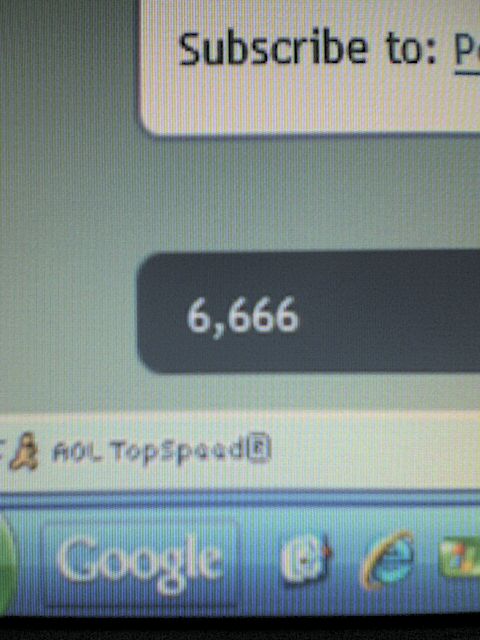
I wrote a post in 2010 reporting that I had reached 6,666 hits, and suggesting it was the number of ten beasts. I doubt I was certain then that I'd still be doing this blog nearly six years later. I've sometimes perused blogs randomly and have found quite a few that begin with a bold statement about what the blogger intends to achieve, and see that the grand plan has crumbled within half a dozen posts. In contrast, this post is my 1,262nd.

Forerunner of this blog
from 9 years ago this month.
So why do we write blogs? I'd say that we all have different reasons: for example, Curmudgeon's blog was originally, at least in part, to argue against the smoking ban, while the Ormskirk Baron reviews bottled beers. Some are campaigning, while others record meanderings around various pubs. Such variety makes them interesting. The original purpose of ReARM was to publicise local real ale and live music events - especially those where both were available. It began in March 2009, replacing the flyers I used to produce and distribute, which I found to be very costly in printing cartridges. By and large, it still serves that function, although its brief has expanded.

I wonder whether it will take me another seven years to clock up the next 100,000.

Friday, 22 January 2016

The price ain't right!

There are some interesting statistics in this article in the Morning Advertiser on a variety of beer-related issues. One set of stats covers the fact that lager sales are declining in favour of ales and craft beers, about which they state:

While some Brits are losing their love of lager, there is a rise in styles such as IPAs (Indian pale ales) in particular.
  • One fifth of UK drinkers are not willing to pay more than £2.99 for a pint. 
  • Three in 10 (29%) beer drinkers are prepared to pay more than £4 per pint.
  • In London, 27% are willing to pay more than £4.50. 
  • More than one quarter (27%) of Brits drink ale or bitter.
  • One in five (20%) drink any type of craft beer.
I found the first point of particular interest. I have long felt that £3 is particularly difficult psychological barrier for many drinkers, and I have wondered whether that's the reason why my local has kept its cask ales below that figure for some time now, except for beers over 5%. I'll pay £2.95 without a thought, but if the cost is over £3, I'll always notice it. It won't stop me paying, of course, but if the price is more than £3 a pint for ordinary beers, I tend to feel it's dear.

One drinker in five is a sizeable proportion of beer drinkers, and this stat suggests to me that it may be a cut-off point for some who may feel driven to join the join the supermarket set. This point is reinforced by the fact that, although lager sales are suffering more than cask ale, the overall consumption of beer in pubs is in slow decline: the market is shrinking.

Pub owners, such as brewers and pub companies who tend to have little compunction about pushing up the prices they charge, should take this psychological price barrier into account, or risk biting the hand that feeds them.

On a related issue, I note that CAMRA is campaigning for another cut in beer duty; let's hope the government heeds the call.

Friday, 1 January 2016

New year rambling thoughts about this blog

I saw New Year in with my brother and sister in law: she was on the red wine while my brother and I drank a 5 litre mini-cask of Wychwood Hobgoblin. Not a fashionable beer, but we enjoyed it, and it was much preferable to beer out of bottles. We hit the sack at around 5.00 a.m.

Today I've been thinking back over my blogging year: I was off line for 6 months until late April 2015, and I did wonder whether I'd be able to revive this blog after such a long period of inactivity. However, looking at the stats, I see that I've had 1035 more unique hits over the year than in my previous peak year (2012), even though that year consisted of a full year of posting. The last two quarters of 2015 were each approximately 30% higher than any previous quarter since I began the blog in March 2009. It's pleasing to know that I'm getting more hits than ever before.

Of my pages (links to the right), the most popular by far is my beer festivals page, and second most popular with a fair number of hits is forthcoming music events. While posts about music are much less likely to attract comments than those relating to beer, I can see that quite a few people do read them.

I saw that Curmudgeon wrote in his review of the year: "Beer blogging itself seems to continue to wither on the vine. I’m likely to record my lowest tally of posts since 2007, which was only a half-year, and it looks as though Tandleman will do the same. I blame Twitter!" I seem to recall Tandleman rhetorically asking about 5 or 6 years ago whether the golden age of beer blogging was over.

I don't know whether there ever was a golden age, but I can't see Twitter taking over from blogs: they serve very different purposes. A detailed analysis, a carefully constructed argument or a comprehensive description cannot be condensed into 140 characters, which seems better suited to saying things like: "Great pint of Old Mudgie in the Sam Smiths Arms tonight, although the Tandleman's Craft Lager was disappointing." I still cannot see much point to Twitter, which is why I'm not on it. Besides I don't have a smart phone, so much of its purpose would be lost.

Dare I suggest that some beer bloggers simply aren't as enthusiastic as they once were? No, I'd better not.

When I began ReARM in 2009, I aimed to post an average of better than one post in every two days, and if you take out the two periods when I was off-line (which total nearly 10 months), I've just about managed that (for info, this is my 1184th post). As I'm sure most other bloggers would agree, while you always want your blog to be current, there are times when you struggle to come up with something to write about, but if you let it fall behind too far, people stop looking at it.

Anyway, enough of all this self-indulgence! It's 1st January and you have a choice: you can go for Dry JanuaryTryanuary or even Try January. Personally, I'll be going for Try2016.

P.S. A Trip To Planet Zog
I was just about to post this when the BBC radio news announced that they are thinking of bringing in new drink guidelines: a recommendation to have two days per week off the booze, and the suggestion that they may bring the limit for men down to match that of women. While I expect most drinkers usually do have a couple of days off, few people take the current limits seriously. As far as I'm concerned, they can announce what they like but I'm sure licensees would be delighted if drinkers limited their consumption to a pint a day. What planet are these people on?

At least they give us bloggers something to write about, so every cloud ...

Saturday, 28 November 2015

7 out of 10 pubs serve real ale

Great news: research* has shown that 70% of pubs now serve real ale'. However, I note that CAMRA says that "micropubs [are] leading the way". I tend to find hyperbole irritating, and this statement is a good example. There are in the UK:
  • 53,444 pubs.
  • 37,356 pubs serving real ale.
  • 150 micropubs.
This means that micropubs represent 0.4% of real ale pubs. The oldest, the Butcher's Arms in Herne, Kent, is now 10 years old, and yet the turnaround in real ale's fortunes goes back a lot longer than that, as we all know. While I fully agree micropubs are a very welcome addition to the real ale scene, I am struggling to see precisely how they are leading the way. As this hype was contained in a CAMRA press release about the next Good Beer Guide, perhaps I shouldn't be surprised: commerce often supplants reality when you've a product to sell.

Still, the good news is that nowadays we generally don't have to hunt very hard to find a reasonable pint as we had to in the past. I say 'generally' because there are certain types of areas in the UK that remain real ale deserts, such as some economically depressed areas, many council estates and anywhere else devoid of a middle class voices and, more importantly, comfortable disposable incomes. The attitude is clearly any old smooth rubbish for the masses. 

* Research conducted using CAMRA's WhatPub database and CGA-CAMRA Pub Tracker.

Thursday, 17 September 2015

Liars, damned liars, and health campaigners

"There are three kinds of lies: lies, damned lies, and statistics." - Mark Twain, who attributed it to Benjamin Disraeli. The point has never been that statistics are inherently bad: it's that their value depends how you compile them, what you include, what you leave out, and whether you have cited them in an appropriate context.

So it is with the cost of alcohol use to the government in England, including the NHS, the police, the criminal justice system and the welfare system. The Institute of Economic Affairs is a think tank that promotes free market economics; it has recently issued a discussion paper called Alcohol and the Public Purse. The IEA is not a source I'd normally quote, but it is undeniably influential and, as far as I know, not known for any bias concerning alcohol per se either way. Its author is Christopher Snowdon, a libertarian opponent of state intervention in matters such as alcohol, smoking and obesity.

The report runs to more than 40 pages, but some of its conclusions include:
  • The £20 billion cost of alcohol use to the UK quoted by public health campaigners is "extremely misleading, conflating social and economic costs (most of which are paid by individuals and businesses) with the costs to government departments (the cost to the taxpayer)".
  • "The best estimate of the gross annual cost of alcohol consumption to state-run services, including the Department of Health, the Department of Work and Pensions, and the Home Office, is £3.9 billion in 2015 prices. This consists £1,954 million to treat alcohol-related injuries and ill health, £1,626 million to tackle alcohol-related crime, and £289 million paid in benefits to those who are unable to work as a result of alcohol-related mental or physical health problems."
  • The IEA has previously said UK alcohol duties should be halved to make them less regressive and bring them closer to duties elsewhere in Europe. This would raise a total of £5,206 million, more if sales went up as a result. Even if they didn't, government income would comfortably exceed government expenditure on alcohol-related problems. 
Cutting duties isn't so unrealistic as it sounds, seeing that UK drinkers still pay 40% of the EU's entire alcohol tax bill, but we'd have to accept that it is politically improbable at present. 

You can find the full report here.

Tuesday, 4 August 2015

Turning the corner

According to the latest Greene King Leisure Spend Tracker, the amount people spent on drinking out rose by 5% in June compared to twelve months previously. The corresponding figure for eating out was 6%. As they say, one swallow doesn't make a booze up, so I look at these figures with some caution - they might be no more than a statistical blip - although the fact that drinking out went up 3% compared to May suggests otherwise (eating out 1% down for the same period).

Other findings included:
  • 27% would like facilities, such as WiFi, to enable them to work away from both the office and home.
  • 64% thought the pub was an important economic and social asset to the community.
  • Only 14% thought pubs should do more to contribute to the local community.
Technology and flexible working mean the pub can be a plausible place to work. A Wetherpoons-style operation with tea, coffee and food as well as alcohol, combined with no music or loud sports, is well suited to benefit from this shift in working practices. Expensive coffee chains benefit from customers arriving with their laptops and getting to work over a coffee, so there's no logical reason why suitable pubs can't do the same.

This is not for every pub, of course, but then we have moved a long way from the essentially similar pubs with similar clientele (and similar beers) that prevailed until the effects of the Beer Orders kicked in more than twenty years ago. Variety in the pub industry is greater now than it has been at any previous time in my 40+ years of pub-going, so work-friendly pubs is a logical development of that diversity.

All this speculation may all be premature - next month could show a massive drop in the spending on drinking out - but I hope not, and I think not. I'll be ready to eat humble pie if I'm wrong.

Friday, 26 June 2015

Survey: why we go to pubs

A survey by Mintel has thrown up a few less-than-astonishing findings. To mention just a few:
  • One in five people in Britain drink in a pub at least once a week.
  • One in ten regularly go to the pub for a meal each week.
  • 22% say food is the most important factor.
  • One in five say they'd visit more often if drinks were cheaper.
Other findings relating to food show that people increasingly expect it to be good quality and made on the premises with locally sourced ingredients; it seems that the attractions of cheap and cheerful pub grub are diminishing (although not for me!). This, the report states, reinforces the importance of food to the pub trade: while I don't disagree, I note that that if 22% consider that food is the most important factor (and that is a lot of people), logically 78% of those surveyed do not. 

The 20% who said they'd go more often if drinks were cheaper constitute a big loss of potential trade; as I've long thought, price is driving people away. Silly duty levels and exorbitant pubco pricing certainly have made pubgoing a costly extravagance for many, especially against a background of a long decline in the value of wages in real terms. I was interested to see that there was no mention of the smoking ban; after eight years, it's probably no longer a significant factor.

There is some acknowledgement of the social and community aspects of pubgoing. Mintel's Chris Wisson said: “In less urban areas in particular, pubs can be an important community space for residents to meet and socialise. Providing an experience more tailored to the local catchment area, by stocking products from local brewers and farmers for example, can be a good way for landlords to underline their importance and relevance to the community.” I can see that, but the same applies to urban pubs, perhaps in a more diluted form owing to the greater choice of pubs that's usually available. I drink mostly in town and city pubs and I have noticed that genuinely local beers do tend to be popular.*

The survey merely reinforces what most of us had assumed anyway: that food is increasingly important to the pub trade. With overall alcohol sales in decline, food makes up some of the shortfall for those pubs that are able to provide it, but that doesn't alter the fact that food isn't the most important factor for nearly four out of five customers. It also doesn't alter the fact that not every pub is able to put food on.

* Hence the significance of Molson Coors' decision to move production of bottled Doom Bar from Cornwall to Burton on Trent.

Sunday, 7 September 2014

Do you want the good news first?

According to the British Beer & Pub Association (BBPA), the number of breweries in the UK has risen 188% since 2000: there are now 1,442. Long gone are the days when a reasonably well-informed beer drinker was familiar with the names of most breweries; nowadays when I travel elsewhere in the UK, I almost always find local breweries I've never heard of. Increased choice is of course good news in general but, contrary to what non-real ale drinkers tend to assume, that doesn't mean that every beer is excellent or that every real ale drinker likes every beer. Despite that, I'd say that overall things are looking good for drinkers who enjoy variety.

However, in the spirit of the beer glass being half empty, there has to be a note of caution. BBPA figures, which are based on tax revenues, show that alcohol sales fell by 1.7% in the year ending in 2013, and by 18% since 2004. There must come a time when declining alcohol sales will curb the increase in the numbers of breweries, and probably lead to some closures; I made a similar point last Wednesday when discussing the related issue of pub closures.

Are the anti-alcohol zealots pleased? Fat chance! As I reported on 14 August, the All-Party Parliamentary Group on Alcohol Misuse (APPG) has come out with a document calling on all political parties to commit themselves to 10 measures to minimise alcohol-related harm in the UK. Despite the official sounding title, this is a group of "self-appointed busybodies with no official status" (to use Curmudgeon's words) who are attempting to influence the manifestos of all parties in the direction of more restrictions.

But it's even worse than that. As Xopher wrote in the comments to my post of 14 August:
  1. The secretariat for the APPG was provided by Alcohol Concern who researched the report.
  2. The APPG secretariat and the printing costs for this report were funded by Lundbeck Ltd.
  3. Lundbeck is a pharmaceutical company which paid for Alcohol Concern's alcohol harm map and report (The Case For Better Access To Treatment For Alcohol Dependence In England). 
  4. Lundbeck sells alcohol dependency drugs in the UK and across Europe.
The fact that Alcohol Concern is itself almost entirely financed from public funds completes the circle whereby the government squanders our money to pay a pressure group to lobby that selfsame government. Using the mechanism of the APPG looks suspiciously like a way of trying to obscure the audit trail. 

And is no one on the APPG bothered about the vested interest that Lundbeck has in helping to steer UK official policy in a way that would boost their own profits? Obviously not.

Enjoy the brewery boom while it lasts.

Friday, 5 September 2014

Quaffing All Over The World

I found an interactive map of alcohol consumption across the globe on the internet. It's interesting, but the UK result will shock you: while we rank among the more committed drinkers, we are by no means the worst on the planet. Surely our friends in Alcohol Concern* couldn't have got it so badly wrong?

Click here for the map.

* A government funded quango granted charity status to save on its tax bill.

Tuesday, 31 December 2013

Hello 2014

I noticed my tally of unique hits reached 60,000 yesterday. Contrary to what my mickey-taking niece suggested, I set the counter to exclude my own visits. I'll be keeping ReARM going because, even though the beer-related posts are the ones that attract most comments, I do know that quite a few people who don't write anything use the blog to find out about local music events. That's fine, being one of the main reasons for the blog in the first place. So ...

Thursday, 28 November 2013

Drink driving hotspots

According to a recent survey, drivers who live in the countryside are twice as likely to be charged with driving under the influence of drink and drugs than town dwellers. The survey was conducted by price comparison website, MoneySuperMarket, based on an analysis of almost 12 million insurance quotes on the site in a 12-month period. The worst areas are the north of Scotland and mid-Wales which both have a conviction rate double that of Greater London. Breaking down the stats further by postcodes shows that Scotland and Wales still dominate the top 10 with Aberdeen, Inverness, Dundee, Kirkcaldy, Cardiff and Swansea all featured, whereas at the bottom end of the table you'll see central London, Bradford, Liverpool and Manchester.

It's not not surprising that rural areas are likely to feature in such lists with pubs generally much further apart, poor or non-existent public transport and a police presence that is much thinner on the ground. All this, however, doesn't fully explain why parts of Scotland and Wales are so prominent, seeing that England too has remote, rural areas, as well as 88% of the UK's population: on the basis of sheer numbers alone, I'd have expected a greater English presence in the top 10.

Can we accept as an explanation that in those areas of Wales or Scotland, you can be even more remote than in England? I don't think so because if you fancy wandering out for a pint, a pub 10 miles away in North Yorkshire is as inaccessible on foot as a pub 30 miles away in the Scottish Highlands, but it could be argued that if you're prepared to drive while over the limit, you may have a longer journey with a greater chance of being breathalysed. Perhaps, but in my view it's more likely that the police being thinner on the ground through trying to cover a larger area might encourage more people to take the chance.

The loss of many village pubs certainly won't have helped. Curmudgeon has blamed such closures, at least in part, on the denormalisation of alcohol by campaigners, which has led to a decline in people being prepared to drive after drinking within the legal limit, thus reducing trade in rural pubs. Fewer rural pubs will mean that many of those prepared to drive after drinking over the limit will have longer journeys.

I'm not making excuses for drink-driving, as my previous posts will make clear (click here if you wish to see them): attempting to understand why something happens doesn't constitute approval. I do wonder, however, whether people who like a drink take the proximity of a decent pub sufficiently into account when choosing where to live, whether in the town or the country, bearing in mind an increasing number of country homes are occupied by incomers. I once visited a college friend who enjoyed his beer and who had moved with his girlfriend to Solihull (admittedly not very rural); he soon made the welcome suggestion that we go for a pint. After 10 or 15 minutes' walk, we reached a pub, but he said that it was no good. After more than half an hour's walk, we reached somewhere reasonable. I asked him why they hadn't chosen a house closer to a pub. He looked at me incredulously and said that you don't take that kind of thing into account when finding somewhere to live. I pointed out that if he'd played golf, he'd have chosen a house near a golf course.

Back to the survey: although it makes interesting reading, bald statistics can't come up with any explanations, and my own attempts are little more than informed guess work. Contacted for a response, the Institute of Advanced Motorists, a self-appointed driving club, began by stating the obvious: "Lack of public transport is no excuse for any (rural) driver to risk a journey under the influence. Offenders may think they stand more chance of getting away with it in quiet rural areas but these roads are actually the most dangerous, with more fatalities than on city streets."

Okay so far, but then the nanny state tendency came out with: "A hard day's work may seem a good justification for a quick pint on the way home but responsibility for your and others [sic] safety comes with every driving licence." In other words, a quick pint on the way home is going to endanger yourself and others, which misses the point that the survey was about people being over the limit. Having a go at legal drink-driving does not address the real problem of those who will get behind the wheel no matter how much they've knocked back.

Monday, 10 June 2013

Unpredictability and stats

I don't spend a great deal of time analysing the stats for this blog, but I decided to have a look today after I noticed that a post I wrote nearly a year ago called "The Lost World of Smoking" had yet again appeared in the list of most read posts. It's a slightly nostalgic piece about how perceptions of smoking have changed in my lifetime, and it also covered my personal experiences, although I have never actually smoked myself, with a non-smoking father who worked in the tobacco industry for about 40 years and a smoking mother. It was definitely not about the smoking ban, which I have covered elsewhere. This is my most read post with 1736 page views, which I find quite extraordinary.

From February 2011, second with 965 page views is "Nothing new under the sun" which explained how moral panics about drinking are nothing new and go back to at least Elizabethan times.

Third with 865 page views was a short piece I wrote in 2009 called "MP's bill to protect pubs". It was about a bill proposed by Greg Mulholland, Lib Dem MP for Leeds North West, to give local amenities such as pubs, banks, chemists, post offices, shops and restaurants extra protection. This gained 865 page views, but I'm not sure why; I had in fact quite forgotten about it. I even managed to get a fact slightly wrong and was corrected by Curmudgeon in the comments section. I have left mistake and correction unaltered.

Perhaps unsurprisingly, posts about the Southport Beer Festival always get quite a lot of page views. The average number of page views per post is 164, but this is deceptive as the range is enormous: a few of my posts in the early days had page views in single figures, a significant contrast to the top three scores. If I had tried to predict what my most read posts might be, I'm sure I'd have got them completely wrong.

Saturday, 9 March 2013

A million miles from 1984

"Britain Slips Down World Death Table" screams the newspaper headline, going on to assert that, "Rising levels of drink and drug abuse are turning Britain into one of the sickest countries in the Western world". Later in the article, the culprits are said to be alcohol, tobacco, high blood pressure and obesity. At face value, this looks plausible, seeing that the UK has gone down from 10 to 14 in the table that compares premature death rates in 19 wealthy nations (which isn't exactly the world, seeing that there are nearly 180 other countries on the planet). In addition, we are told that cases of cirrhosis of the liver, usually attributed to alcohol, have risen by 65% between 1990 and 2010.

It's not looking good for us, except that the article later states that the UK's average life expectancy has risen by 4.2 years between 1990 and 2010; it's now 79.9 years. So are we getting sicker or not? Clearly, if life expectancy is increasing, our general health must be improving, but that's not the message the headline conveys, i.e. that we are going down, when in fact we are simply going up more slowly than some other countries, but that doesn't make such a good story, does it? It does irritate me that statistics are being misrepresented for the sake of a good, shock-horror news story. Birkonian has a few other observations about the report too.

The cirrhosis statistic cannot so easily be dismissed, but I can't help wondering whether the draconian policies of successive governments concerning under age drinking haven't contributed to the problem. When I was drinking under age, we did it in pubs, drinking a few pints in a well-behaved manner (you didn't want to draw attention to yourself and be thrown out). As well as limiting the amount of alcohol you consumed, you also developed good drinking habits.

Not so now: you can buy a cheap bottle of vodka for the price of 3 or 4 pints, drink it at home, in the park or, as I saw recently, on the train going to a night out. Necking vodka quickly, even diluted with a soft drink, inflicts a massive alcohol hit on the system that cannot be achieved by drinking beer. When I was in my teens and twenties, drinking spirits was a rarity; now it's commonplace with young people, and has been for a while. I am certain that the Law of Unintended Consequences is at work here, in that legislation designed to protect young people from the damage that alcohol can undoubtedly cause, especially to a body that hasn't finished developing, is in reality driving many young people in a direction of greater damage. I'm not suggesting this explains all of the 65% rise in cirrhosis, but I'd be very surprised if it weren't a contributory factor. In other words, the cure is making the problem worse. Not only that, unregulated drinking is much more likely to lead to antisocial behaviour than drinking in a pub or bar.

It's a pity that health campaigners and public policy makers don't take a more holistic view of the problem and the potential effects of their suggested solutions. Instead we are given dubious university research that suggests that a rise in alcohol prices of X per unit will result in saving of Y number of lives, coupled with further demands to rack up the penalties on licensees who serve under age drinkers. Last year, when the BBC quoted completely inaccurate figures in a programme about the effects of alcohol on older drinkers (the mistake was the university researchers', not the BBC's), I demanded that they correct the information in a later broadcast of the programme concerned. They said they'd corrected it on the website, and my argument that most people who had seen the programme were unlikely to look at the website was dismissed. The logical conclusion is that it's okay to broadcast duff info in error and not correct it, as long as that misinformation supports the anti-alcohol campaigners' cause. I'm certain if the errors had gone the other way, the Beeb would caved in to pressure to broadcast a correction on air.

That's what we have to deal with nowadays; it's not a million miles away from 1984, is it?

Sunday, 9 December 2012

Sorry, stats again!

I didn't intend to come back to this topic so soon, having discussed it last month when I said that "the number of hits I received in October was helped partly by all the information I published about the Southport Beer Festival, so no doubt I'll get fewer hits this month now that's over. Perhaps I'll have a corresponding jump in the [beer] blog rankings."

Well, the number of hits has dropped as expected, although not down to its previous level (thanks folks!), but my tongue in cheek suggestion I'll jump in the blog rankings has, to my surprise, actually come about: up 26 places to 38, the highest position ever. Yet again I can't make any sense of it, and in the up-down nature of these things, I'm not holding my breath I'll stay there.

Still, it's nice to see that figure on the blog (bottom of right hand column), if only fleetingly. If you'd like to look at who else is in the beer blog Hot 100, click here.

P.S. Looking at the statcounter to see where the visits to the blog are coming from, I was surprised to see that only 65.4% are from the UK (it's usually around 90%), with 13.4% from the USA and 5.6% from Finland, although it likely that some of the Finnish ones might be accounted for by Harri, the real ale hunter from Finland whom I met at the beer festival.

Thursday, 15 November 2012

Stats

Last month, October, saw the highest number of hits this blog has ever had since I began it in March 2009. My ranking in the top 100 beer blogs has during the same period dropped by 12 places to 64. I do understand that the number of hits isn't how the rankings are determined. They explain it this way: "Blog ranking according to the score calculated by ebuzzing, based on various parameters (network of links to the blog coming from other blogs, shares of its articles on facebook, Twitter, …)"*, but I can't help feeling it odd that the main measure of a blog's success, i.e. how any people are reading it, doesn't count. I therefore can't take the rankings too seriously, even when, as has happened, I go up, because I fully expect to come down the following month, and I usually do.

The number of hits I received in October was helped partly by all the information I published about the Southport Beer Festival, so no doubt I'll get fewer hits this month now that's over. Perhaps I'll have a corresponding jump in the blog rankings.

That is, presumably, in English.

Thursday, 8 September 2011

Beer festivals and stats

Looking at the stats for this blog, I see that my updated beer festival page is by far the most popular one on the blog with 83 recent hits, followed by my events page with 36.  I've included every kind of beer festival I can find, including those organised by CAMRA, Rotary, pubs, sports and social clubs and charities.  I've gone as far afield as Cumbria, Cheshire and the Manchester area because drinkers are often prepared to travel to a festival they like the look of.  Besides, there may be a few people in those areas who read this blog.  I also included one in Belgrade for a laugh, but I'm not sure anyone noticed.  There is of course looming close now our own Sandgrounder Beer Festival in Southport from 22 to 24 September - more info here.

While on the subject of stats, the 2nd anniversary of me installing the stats counter has just been reached (I installed it when the blog was 6 months old) on 1 September. In the first year of the counter, I got 7138 hits; in the second year the figure was 14,961, which is slightly more than double. I'm pleased about this indication that people find the blog a useful source of information which isn't collated anywhere else as far as I know.  And you definitely won't find my views, opinions and rants about beer and music anywhere else at all - for which no doubt some people will be eternally grateful!

Tuesday, 10 August 2010

Ten beasts?

Looking at the visitor counter on ReARM just now, I noticed that it's just reached 6,666 ~ the number of ten beasts?

This blog was originally set up in March 2009 to replace the flyers about local music events in real ale pubs which I used to print and pass around the places I went to. I'm sure most of them ended up as waste paper unread, as is the nature of such things. I felt it wasn't a very effective way of disseminating information, until I got the idea of a blog from chatting to my old friend Tandleman at the National Winter Ale Festival.

I didn't install the counter until September. You can choose any starting figure, so I could have started it at - say - ten thousand, but chose 0. The stats counter tells me that the most popular page is the events page, which is good, seeing it's the reason why I set up the blog in the first place. The Southport Beer Festival is currently the second most popular page, and various of my postings have followed close behind. I'll never attain the readership that some other bloggers do because of the very local nature of much of what I write, although I was interested to see I've had one reader from Korea in the last few days. There always seems to be a few Americans and a selection from other countries, but 94.8% are unsurprisingly from Britain.

There are peaks and troughs - the highest figure for visitors in one day is 76 and the lowest is 4 - but overall the number of readers is slowly rising, so I think it's worth continuing.

Now that I've finished typing this, it's up to 6,669.

Thursday, 3 June 2010

Rearming the beer festival

Looking at ReARM's stats for the last week, I was surprised to see that the most viewed item was the page on the Southport beer festival (9th to 11th September - link on the left). Close behind were the posting about InBev offloading Bass (2nd) and the "Events" page (3rd - link on left also). As one of the main purposes of this blog is to provide information of what's going on, I'm pleased that the pages giving that information are in the top three. Below the top three are postings on various topics, mostly recent but some from quite a while ago; it's clear that some people like to go back to find what I've written in the past.

Why was I surprised at the beer festival being number one? Quite simple: the festival is more than 3 months away and I wouldn't have thought that many people would be planning so far ahead. Just shows how wrong you can be.

I designed the oval ReARM badge to look like a pump clip or beer mat ~ I'm not sure I succeeded, but I quite like it anyway!